

All Lose pays 0.7:1.
RTP
The optimal theoretical return-to-player percentage:
- 3 Card Hand – 96.69%
- 5 Card Hand – 95.21%
- 7 Card Hand – 94.34%
- All Lose – 96.29%
Casino Hold’em
Game Rules
- Casino Hold'em is a variant of the popular Texas Hold'em poker. Casino Hold'em differs from Texas Hold'em in that it is played against the house rather than against other players.
- The aim of Casino Hold'em is to beat the dealer's hand by getting the best possible five-card hand, made out of the two cards dealt to the player and five community cards.
- An unlimited number of players can play simultaneously at one Casino Hold'em table. Each player can take only one seat by the table.
- Casino Hold'em is played with one standard 52 card deck (Jokers are excluded). Only one game is played with one deck of cards, and cards are shuffled after each game round.
- To play the game you place a bet on the Ante bet (initial bet). To add to the excitement, you can also place a Bonus bet that pays out if a pair of Aces or higher is dealt in the first five cards.
- The dealer deals out two cards face-up to you and two cards face-down to the dealer. Three community cards are dealt face-up in the middle of the table. These three community cards are common for you and the dealer for making up the hand.
- You must decide whether to PLAY 2X or FOLD. Choose PLAY 2X to continue the round by placing a Play bet equal to double your Ante. Choose FOLD to end the round, thereby forfeiting your Ante bet. Bonus bet is not effected by PLAY/FOLD decision. Note that you must choose PLAY to receive a payout on your Bonus bet.
- After you have made your decision, the dealer will deal two more community cards (called "Turn" and "River"). The dealer will also reveal his/her two initial cards.
- To find a winner, the best paying hands are formed and compared for you and for the dealer, using five out of seven available cards.
Side Bets
BONUS BET
The Bonus bet is an optional bet and cannot be placed alone. After a chip is placed on the Ante bet spot a flashing arrow will show you that the Bonus bet spot is activated. Place your Bonus bet in the same way as you place the Ante bet.
The Bonus bet is evaluated on the first hand of five cards only. If you have a Pair of Aces or better combination, you will win the Bonus bet and will be paid according to the Bonus pay table.
Jumbo 7 Jackpot Bet
- The Jumbo 7 Jackpot bet is an optional side bet that allows you to win a share of the large progressive jackpot! The amount of the progressive jackpot grows steadily over time as more Jumbo 7 Jackpot bets are placed by players at several different participating casinos. Eventually, the jackpot is hit when a player who has placed a Jumbo 7 Jackpot bet at a participating table gets a 7 Card Straight Flush – created by your two and the five community cards.
- All players who have placed a Jumbo 7 Jackpot bet in the winning game round share the total amount of the progressive jackpot. The amount of your potential share of the progressive jackpot is thus based on all Jumbo 7 Jackpot bets that have been placed by players at participating game tables in the current round.
- The optional Jumbo 7 Jackpot bet also allows you to win an additional prize of a fixed amount when you personally get a Straight or better! At the start of a new game round, place your optional Jumbo 7 Jackpot bet in the circular field labelled "Jumbo 7 JACKPOT" after you have placed your ante bet and before betting time expires.
- Once accepted, your Jumbo 7 Jackpot bet will be added to the total amount of the progressive jackpot. Each participating player places the Jumbo 7 Jackpot bet in the currency used at his/her casino, and the current amount of the progressive jackpot and your potential share of the progressive jackpot are displayed in your currency in the Jumbo 7 JACKPOT paytable. When you win a share of the progressive jackpot, you will be paid in your own currency.
- The fixed prizes for getting a good hand (from a Straight to a 6 Card Straight Flush) are also displayed in your own currency.
- Your decision to PLAY 2X or FOLD your hand does not affect your ability to win a share of the progressive jackpot in the game round.
- If the game round is cancelled, your Jumbo 7 Jackpot bet will be refunded along with your other bets. If you held a potential prize-winning hand according to the Jumbo 7 JACKPOT paytable in a cancelled game round, the decision to manually compensate you will be made by your game provider.
Winning Hands
The individual cards are ranked in descending order: Ace (high or low), King, Queen, Jack, 10, 9, 8, 7, 6, 5, 4, 3 and 2.
An Ace can be the highest value card in a Straight of A, K, Q, J, 10 or the lowest value card in a Straight of 5, 4, 3, 2, A.
Possible hands from the highest payouts to the lowest:
- Royal Flush is a Straight Flush that contains the Ace, King, Queen, Jack and 10 all in the same suit. In the case of a tie, the player gets their initial bet back and the outcome of the game is a PUSH.
- Straight Flush is a hand that contains five cards in sequence, all of the same suit, for example: Nine, Eight, Seven, Six and Five, all Hearts. Two Straight Flushes are ranked by comparing the highest card of each. In the case of a tie, the player gets their initial bet back and the outcome of the game is a PUSH.
- Four of a Kind is a hand that contains all four cards of one rank plus any other card. For example, four Aces in your hand would be Four of a Kind. Quads with higher ranking cards defeat those with lower ranking cards. If two Four of a Kinds are of equal rank the fifth card (the ‘Kicker’) is used to break the tie. In the case of a tie, the player gets their initial bet back and the outcome of the game is a PUSH.
- Full House is a hand that contains three matching cards of one rank and two matching cards of another rank, e.g. three Kings and two Sixes. Between two Full House hands, the one with the higher ranking three cards wins. In the case of the three cards being of the same value in Full House (and therefore tied), the two cards of the same value are ranked against each other. In the case of a tie, the player gets their initial bet back and the outcome of the game is a PUSH.
- Flush is a hand where all five cards are of the same suit, but not sequential, e.g. five
- cards that are all Clubs. Two Flushes are compared as if they were high card hands; the highest-ranking card in each hand is compared to determine the winner. If both hands have the same highest card, then the second-highest ranking card is compared, and so on until a difference is found.
- Straight is a hand that contains five cards of sequential rank in at least two different suits, e.g. Nine, Eight, Seven, Six and Five in two or more suits. Two Straights are ranked by comparing the highest card in each hand. Two Straights with the same high card are of equal value and therefore tie, as suits are not used to separate them.
- Three of a Kind is a hand that contains three cards of the same rank, plus two cards which are not of this rank or the same as each other. For example, a player having three Kings in their hand would have Three of a Kind. Higher valued Three of a Kind defeats lower-valued Three of a Kind. If two hands contain Three of a Kind of the same value, the Kickers (that is, the other two cards in the hand) are compared to break the tie.
- Two Pairs is a hand that contains two cards of the same rank, plus two cards of another rank (that match each other but not the first pair), plus any card not of either rank. An example of this would be having two Aces and two Kings. To rank two hands both containing Two Pairs, the higher-ranking pair of each is first compared, and the higher pair wins. If both hands have the same top pair, then the second pair of each is compared. If both hands have the same two pairs, the highest value Kicker determines the winner.
- Pair is a hand that contains two cards of one rank (e.g. two Kings), plus three cards which are not of this rank or the same as each other. Pair is the lowest hand you can be paid out for. Higher ranking pairs defeat lower ranking pairs. If two hands have the same pair, the Kickers are compared in descending order and the highest value Kicker determines the winner.
- High Card is a poker hand made of any five cards not meeting any of the above requirements. Essentially, no hand is made, and the only thing of any meaning in the player's hand is their highest card. If two hands have the same High Card value, the other cards in the hand are compared in descending order to determine the winner.
Game Outcomes and Payouts
- The outcomes are determined by comparing the player’s and dealer’s best five-card hands (combining the player/dealer two cards with the five community cards).
- The dealer must have a pair of fours or higher to qualify. Outcomes quick-reference table
- The quick way to check game outcomes, whether you win, lose or tie.
*7 Card Straight Flush, 6 Card Straight Flush and 5 Card Straight Flush – a hand containing seven, six or fivecards in sequence respectively, all in the same suit. Examples of each are shown below.
- Example of a 7 Card Straight Flush: Ace, 2, 3, 4, 5, 6, 7, all in the same suit.
- Example of a 6 Card Straight Flush: Ace, 2, 3, 4, 5, 6, all in the same suit.
- Example of a 5 Card Straight Flush: 9, 8, 7, 6, 5, all in the same suit. (Please note that Royal Flush is a 5 CardStraight Flush for Jackpot.)
**The progressive jackpot, stated in your own currency, is the top prize shared among all players who haveplaced a Jumbo 7 Jackpot bet in the winning game round.
The prizes you can win individually for a hand of Three of a Kind or better (up to a Straight Flush) are indicated in your own currency.
Play bet payout is 1:1.
Malfunction voids all pays and play.
Return to Player
The optimal theoretical percentage return to the player for the Ante bet is 97.84% and for the Bonus bet is 93.74%.
The optimal theoretical return-to-player percentage for Jumbo 7 JACKPOT bet is 81.64%.
2 Hand Casino Hold’em
Game Objective
- 2 Hand Casino Hold'em is a variant of the popular Casino Hold'em poker game, allowing you to play one or two hands. The game is played against the house rather than against other players.
- The aim of 2 Hand Casino Hold'em is to beat the dealer's hand by getting the best possible five-card hand, made out of the player’s first two cards and the five community cards. Each of the player’s hands is compared with the dealer’s hand independently. The best poker hand wins.
- An unlimited number of players can play simultaneously at one 2 Hand Casino Hold'em table. Each player sharing the same hand may take only one seat at the table.
- 2 Hand Casino Hold'em is played with one standard 52 card deck and the cards are shuffled after each game round.
- To play the game, place your bet on the Ante bet spot individually for each of your two hands within the betting time. You may also place an additional Bonus bet that pays out if a pair of Aces or better combination is dealt in the first five cards. The Bonus bet is evaluated for each hand independently on the first five cards (3 community cards dealt in Flop, plus your two initial cards).
- The dealer deals two face-up cards to you and two face-down cards to him/herself. The dealer then deals the first three community cards (the Flop) in the middle of the table. These three cards are common for you and the dealer for making up a poker hand.
- You must now decide whether to PLAY or FOLD. Choose PLAY to continue the round by placing a Play bet, equalling twice the Ante bet. Choose FOLD to end the round, thereby forfeiting your Ante bet. The Bonus bet is not affected by your PLAY/FOLD decision.
- After you have made your decision, the dealer will deal two more community cards (called Turn and River).
- The dealer will also reveal his/her two initial cards.
- To find a winner, the best paying hands are formed and compared for you and for the dealer, using five out of seven available cards.
Side Bets
BONUS BET
The Bonus bet is an optional bet and cannot be placed alone. After a chip is placed on the Ante bet spot the Bonus bet spot is activated. Place your Bonus bet in the same way as you place the Ante bet.
The Bonus bet is evaluated for each hand independently on the first five cards (3 community cards dealt in Flop, plus your two initial cards). You win the Bonus bet, if you have a Pair of Aces or better combination and it pays out according to the Bonus pay table. For details, see ‘Game Outcomes and Payouts’.
Winning Hands
- The individual cards are ranked in descending order: Ace (high or low), King, Queen, Jack, 10, 9, 8, 7, 6, 5, 4, 3 and 2.
- An Ace can be the highest value card in a Straight of A, K, Q, J, 10 or the lowest value card in a Straight of 5, 4, 3, 2, A.
- Possible hands from the highest payouts to the lowest:
- Royal Flush is a Straight Flush that contains the Ace, King, Queen, Jack and 10 all in the same suit. In the case of a tie, the player gets their initial bet back and the outcome of the game is a PUSH.
- Straight Flush is a hand that contains five cards in sequence, all of the same suit, for example: Nine, Eight, Seven, Six and Five, all Hearts. Two Straight Flushes are ranked by comparing the highest card of each. In the case of a tie, the player gets their initial bet back and the outcome of the game is a PUSH.
- Four of a Kind is a hand that contains all four cards of one rank plus any other card. For example, four Aces in your hand would be Four of a Kind. Quads with higher ranking cards defeat those with lower ranking cards. If two Four of a Kinds are of equal rank the fifth card (the ‘Kicker’) is used to break the tie. In the case of a tie, the player gets their initial bet back and the outcome of the game is a PUSH.
- Full House is a hand that contains three matching cards of one rank and two matching cards of another rank, e.g. three Kings and two Sixes. Between two Full House hands, the one with the higher ranking three cards wins. In the case of the three cards being of the same value in Full House (and therefore tied), the two cards of the same value are ranked against each other. In the case of a tie, the player gets their initial bet back and the outcome of the game is a PUSH.
- Flush is a hand where all five cards are of the same suit, but not sequential, e.g. five cards that are all Clubs. Two Flushes are compared as if they were high card hands; the highest-ranking card in each hand is compared to determine the winner. If both hands have the same highest card, then the second-highest ranking card is compared, and so on until a difference is found.
- Straight is a hand that contains five cards of sequential rank in at least two different suits, e.g. Nine, Eight, Seven, Six and Five in two or more suits. Two Straights are ranked by comparing the highest card in each hand. Two Straights with the same high card are of equal value and therefore tie, as suits are not used to separate them.
- Three of a Kind is a hand that contains three cards of the same rank, plus two cards which are not of this rank or the same as each other. For example, a player having three Kings in their hand would have Three of a Kind. Higher-valued Three of a Kind defeats lower-valued Three of a Kind. If two hands contain Three of a Kind of the same value, the Kickers (that is, the other two cards in the hand) are compared to break the tie.
- Two Pairs is a hand that contains two cards of the same rank, plus two cards of another rank (that match each other but not the first pair), plus any card not of either rank. An example of this would be having two Aces and two Kings. To rank two hands both containing Two Pairs, the higher ranking pair of each is first compared, and the higher pair wins. If both hands have the same top pair, then the second pair of each is compared. If both hands have the same two pairs, the highest value Kicker determines the winner.
- Pair is a hand that contains two cards of one rank (e.g. two Kings), plus three cards which are not of this rank or the same as each other. Pair is the lowest hand you can be paid out for. Higher ranking pairs defeat lower ranking pairs. If two hands have the same pair, the Kickers are compared in descending order and the highest value Kicker determines the winner.
- High Card is a poker hand made of any five cards not meeting any of the above requirements. Essentially, no hand is made, and the only thing of any meaning in the player's hand is their highest card. If two hands have the same High Card value, the other cards in the hand are compared in descending order to determine the winner.
Game Outcomes and Payouts
- The outcomes are determined by comparing the player’s and dealer’s best five-card hands (combining the player/dealer two cards with the five community cards).
- The dealer must have a pair of fours or higher to qualify.
- Outcomes quick-reference table
- The quick way to check game outcomes, whether you win, lose or tie.
Malfunction voids all pays and play.
Return to Player
The optimal theoretic percentage return to the player for the Ante bet is 97.84% and for the Bonus bet is93.74%.
Texas Hold’em Bonus
Game Rules
Texas Hold’em Bonus Poker is a variant of the popular Texas Hold'em Poker but differs in that it is played against the house rather than against other players and there is no bet after the River card.
The game uses one 52-card deck which is shuffled after each game round.
- All players play the same hand.
- To begin the game, the player must make an ANTE bet (initial bet).
- If interested, the player can make the optional BONUS and FIRST 5 JACKPOT bets (ANTE bet is required).
Both the player and dealer receive two starting cards (the hole cards).
- The player's cards are dealt face-up.
- The dealer's cards are dealt face-down.
The player has a choice after these initial cards are dealt:
- FOLD (surrender their ANTE bet) in which case the hand is over, or
- Make a PLAY 2x bet of 2x their ANTE.
The dealer deals three FLOP cards and the player has a choice:
- PLAY 1x (1x ANTE)
- CHECK (No bet)
The dealer deals one TURN card and the player has a choice:
- PLAY 1x (1x ANTE)
- CHECK (No bet)
The dealer then deals a final card, called the RIVER, and reveals his/her cards.
The ANTE bet is evaluated by comparing the player’s and dealer’s best five-card poker hand out of the seven dealt cards (your two cards, the dealer’s two cards and the five community cards).
Side Bets
BONUS bet
The BONUS bet is an optional bet and can be placed after your minimum ANTE bet is placed. Simply place your bet on the BONUS bet spot.
The BONUS bet is evaluated based only on the player’s and dealer’s initial cards, according to the Bonus pay table.
BONUS bet
You win your BONUS bet if you have a Pair or better, according to the Bonus bet pay table, no matter what hand the dealer achieves. The combination is evaluated on the basis of the two cards dealt to the player, except for the "A-A (Player & Dealer)" combination, which also takes into account the two cards dealt to the dealer.
FIRST 5 JACKPOT bet
- The FIRST 5 JACKPOT bet is an optional side bet that allows you to win a share of the large progressive jackpot! The amount of the progressive jackpot grows steadily over time as more FIRST 5 JACKPOT bets are placed by other players. Eventually, the jackpot is hit when a player who has placed a FIRST 5 JACKPOT bet at a participating table gets a Royal Flush.
- All players who have placed a FIRST 5 JACKPOT bet in the winning game round share the total amount of the progressive jackpot. The amount of your potential share of the progressive jackpot is thus based on the current value of the jackpot, plus all the FIRST 5 JACKPOT bets that have been placed by players at participating game tables in the current round.
- The optional FIRST 5 JACKPOT bet also allows you to win an additional prize of a fixed amount when you personally get a hand of Three of a Kind or better!
- At the start of a new game round, place your optional FIRST 5 JACKPOT bet after you have placed your ANTE bet and before the betting time expires.
- Once accepted, your FIRST 5 JACKPOT bet will be added to the total amount of the progressive jackpot. Each participating player places the FIRST 5 JACKPOT bet in the currency used at his/her casino, and the current amount of the progressive jackpot and your potential share of the progressive jackpot are displayed in your currency in the FIRST 5 JACKPOT pay table. When you win a share of the progressive jackpot, you will be paid in your own currency.
- The winning hands that qualify for the lower-level fixed prizes in the jackpot (from Three of a Kind to a Straight Flush) are also displayed in your own currency.
- Your decision to PLAY or FOLD your hand does not affect your ability to win a share of the progressive jackpot in the game round, or your ability to win one of the fixed prizes from the FIRST 5 JACKPOT pay table.
- If the game round is cancelled, your FIRST 5 JACKPOT bet will be refunded along with your other bets. If you held a potential prize-winning hand according to the FIRST 5 JACKPOT pay table in a cancelled game round, the decision to compensate you manually will be made by your game provider.
Winning Hands
- The individual cards are ranked in descending order: Ace (high or low), King, Queen, Jack, 10, 9, 8, 7, 6, 5, 4, 3 and 2.
- An Ace can be the highest value card in a Straight of A, K, Q, J, 10 or the lowest value card in a Straight of 5, 4, 3, 2, A.
Possible hands from the highest payouts to the lowest:
- Royal Flush is a Straight Flush that contains the Ace, King, Queen, Jack and 10 all in the same suit. In the case of a tie, the player gets their initial bet back and the outcome of the game is a PUSH.
- Straight Flush is a hand that contains five cards in sequence, all of the same suit, for example: Nine, Eight, Seven, Six and Five, all Hearts. Two Straight Flushes are ranked by comparing the highest card of each. In the case of a tie, the player gets their initial bet back and the outcome of the game is a PUSH.
- Four of a Kind is a hand that contains all four cards of one rank plus any other card. For example, four Aces in your hand would be Four of a Kind. Quads with higher ranking cards defeat those with lower ranking cards. If two Four of a Kinds are of equal rank the fifth card (the ‘Kicker’) is used to break the tie. In the case of a tie, the player gets their initial bet back and the outcome of the game is a PUSH.
- Full House is a hand that contains three matching cards of one rank and two matching cards of another rank, e.g. three Kings and two Sixes. Between two Full House hands, the one with the higher ranking three cards wins. In the case of the three cards being of the same value in Full House (and therefore tied), the two cards of the same value are ranked against each other. In the case of a tie, the player gets their initial bet back and the outcome of the game is a PUSH.
- Flush is a hand where all five cards are of the same suit, but not sequential, e.g. five cards that are all Clubs. Two Flushes are compared as if they were high card hands; the highest-ranking card in each hand is compared to determine the winner. If both hands have the same highest card, then the second-highest ranking card is compared, and so on until a difference is found.
- Straight is a hand that contains five cards of sequential rank in at least two different suits, e.g. Nine, Eight, Seven, Six and Five in two or more suits. Two Straights are ranked by comparing the highest card in each hand. Two Straights with the same high card are of equal value and therefore tie, as suits are not used to separate them.
- Three of a Kind is a hand that contains three cards of the same rank, plus two cards which are not of this rank or the same as each other. For example, a player having three Kings in their hand would have Three of a Kind. Higher-valued Three of a Kind defeats lower-valued Three of a Kind. If two hands contain Three of a Kind of the same value, the Kickers (that is, the other two cards in the hand) are compared to break the tie.
- Two Pairs is a hand that contains two cards of the same rank, plus two cards of another rank (that match each other but not the first pair), plus any card not of either rank. An example of this would be having two Aces and two Kings. To rank two hands both containing Two Pairs, the higher ranking pair of each is first compared, and the higher pair wins. If both hands have the same top pair, then the second pair of each is compared. If both hands have the same two pairs, the highest value Kicker determines the winner.
- Pair is a hand that contains two cards of one rank (e.g. two Kings), plus three cards which are not of this rank or the same as each other. Pair is the lowest hand you can be paid out for. Higher ranking pairs defeat lower ranking pairs. If two hands have the same pair, the Kickers are compared in descending order and the highest value Kicker determines the winner.
- High Card is a poker hand made of any five cards not meeting any of the above requirements. Essentially, no hand is made, and the only thing of any meaning in the player's hand is their highest card. If two hands have the same High Card value, the other cards in the hand are compared in descending order to determine the winner.
Game Outcomes and Payouts
The outcomes are determined by comparing the player’s and dealer’s best five-card hands (combining the player’s initial two cards, the dealer’s initial two cards with the five community cards). The higher hand wins. If the dealer has a higher hand the player will lose all bets, except:
- Possibly the BONUS bet, which is evaluated separately.
- Possibly the FIRST 5 JACKPOT bet, which is also evaluated separately.
If the player has a higher hand the Flop, Turn, and River bets will pay even money. If the player has a Straight or higher the Ante bet will also pay even money, otherwise, it will push.
If the player and dealer have hands of equal value the Ante, Flop, Turn and River bets will all push.
Outcomes quick-reference table
The quick way to check game outcomes, whether you win, lose or push.
Three of a Kind 3
*Jackpot is divided between all players from the same table who have placed a FIRST 5 JACKPOT bet in the particular game round.
Only the player’s first five cards are evaluated for a possible winning Jackpot hand – that is, the player’s initial two cards and the first three community cards (the “Flop”).
Malfunction voids all pays and play.
Return to Player
The theoretical Return-To-Player assuming perfect play is:
- Main game: 97.96% based on the Ante bet and 99.47% based on Total bet.
- Bonus bet: 91.46%
- First 5 Jackpot bet: 81.84%
Ultimate Texas Hold’em
Game Rules
- Ultimate Texas Hold'em is a variant of the popular Texas Hold'em poker. Ultimate Texas Hold'em differs from Texas Hold'em in that it is played against the house rather than against other players.
- The aim of Ultimate Texas Hold'em is to beat the dealer's hand by getting the best possible five-card hand, made out of the two cards dealt to the player and the five community cards dealt to the middle of the table.
- An unlimited number of players can play simultaneously at one Ultimate Texas Hold'em table. Each player can take only one seat at the table.
- Ultimate Texas Hold'em is played with one standard 52-card deck (jokers excluded). The deck is shuffled after every game round.
- At the beginning of the round, you place a bet in the ANTE spot. When your ANTE bet has been placed, a BLIND bet of the same value is automatically placed for you by the system.
- The dealer deals two cards face up to you and two cards face down to the dealer. After a short pause, the dealer deals with three community cards face up in the middle of the table (called the "Flop"). After a pause, the dealer deals with two final community cards (called the "Turn" and the "River").
- You and the dealer can use the cards in your hand and the community cards to make the best five-card hand. During the pauses in the game, you can decide to PLAY or CHECK.
- The PLAY bet gives you three different opportunities during the game round to raise your ANTE bet. However, you may only raise once during each game round. The earlier you raise, the more money you can bet and the more you can potentially win. CHECK means you do nothing – you just stick with your initial bet.
- To find a winner, the best-paying hands are formed and compared for you and for the dealer, using five out of seven available cards.
Side Bets
TRIPS BET
The TRIPS bet is an optional side bet that you can place before the game round begins. This bet is placed in the blinking TRIPS betting spot, after your ANTE bet has been accepted. You win on your TRIPS bet when your final five-card hand is Three-of-a-Kind or better, no matter what hand the dealer achieves.
All bets must be placed before betting time expires. Once betting time has expired, the dealer will begin to deal. During the game round, you will be offered opportunities to place a PLAY bet, but your PLAY bet decisions will not affect the outcome of your TRIPS bet. At the end of the round, the dealer turns all his/her cards face up and announces the result. Winning players are also notified by an on-screen animation.
Winning Hands
The individual cards are ranked in descending order: Ace (high or low), King, Queen, Jack, 10, 9, 8, 7, 6, 5, 4, 3, and 2.
An Ace can be the highest value card in a Straight of A, K, Q, J, 10 or the lowest value card in a Straight of 5, 4, 3, 2, A.
Possible hands from the highest payouts to the lowest:
- Royal Flush is a Straight Flush that contains the Ace, King, Queen, Jack, and 10 all in the same suit. In the case of a tie, the player gets their initial bet back and the outcome of the game is a PUSH.
- Straight Flush is a hand that contains five cards in sequence, all of the same suit, for example: Nine, Eight, Seven, Six and Five, all Hearts. Two Straight Flushes are ranked by comparing the highest card of each. In the case of a tie, the player gets their initial bet back and the outcome of the game is a PUSH.
- Four of a Kind is a hand that contains all four cards of one rank plus any other card. For example, four Aces in your hand would be Four of a Kind. Quads with higher ranking cards defeat those with lower ranking cards. If two Four of a Kinds are of equal rank the fifth card (the ‘Kicker’) is used to break the tie. In the case of a tie, the player gets their initial bet back and the outcome of the game is a PUSH.
- Full House is a hand that contains three matching cards of one rank and two matching cards of another rank, e.g. three Kings and two Sixes. Between two Full House hands, the one with the higher ranking three cards wins. In the case of the three cards being of the same value in Full House (and therefore tied), the two cards of the same value are ranked against each other. In the case of a tie, the player gets their initial bet back and the outcome of the game is a PUSH.
- Flush is a hand where all five cards are of the same suit, but not sequential, e.g. five cards that are all Clubs. Two Flushes are compared as if they were high card hands; the highest-ranking card in each hand is compared to determine the winner. If both hands have the same highest card, then the second-highest ranking card is compared, and so on until a difference is found.
- Straight is a hand that contains five cards of sequential rank in at least two different suits, e.g. Nine, Eight, Seven, Six, and Five in two or more suits. Two Straights are ranked by comparing the highest card in each hand. Two Straights with the same high card are of equal value and therefore tie, as suits are not used to separate them.
- Three of a Kind is a hand that contains three cards of the same rank, plus two cards that are not of this rank or the same as each other. For example, a player having three Kings in their hand would have Three of a Kind. Higher-valued Three of a Kind defeats lower-valued Three of a Kind. If two hands contain Three of a Kind of the same value, the Kickers (that is, the other two cards in the hand) are compared to break the tie.
- Two Pairs is a hand that contains two cards of the same rank, plus two cards of another rank (that match each other but not the first pair), plus any card not of either rank. An example of this would be having two Aces and two Kings. To rank two hands both containing Two Pairs, the higher ranking pair of each is first compared, and the higher pair wins. If both hands have the same top pair, then the second pair of each is compared. If both hands have the same two pairs, the highest value Kicker determines the winner.
- Pair is a hand that contains two cards of one rank (e.g. two Kings), plus three cards that are not of this rank or the same as each other. Pair is the lowest hand you can be paid out for. Higher ranking pairs defeat lower ranking pairs. If two hands have the same pair, the Kickers are compared in descending order and the highest value Kicker determines the winner.
- High Card is a poker hand made of any five cards not meeting any of the above requirements. Essentially, no hand is made, and the only thing of any meaning in the player's hand is their highest card. If two hands have the same High Card value, the other cards in the hand are compared in descending order to determine the winner.
Game Outcomes and Payouts
The outcomes are determined by comparing the player’s and dealer’s best 5 card hands (combining the player/dealer 2 cards with the 5 community cards).
The dealer must have a pair or better to qualify.
If the player wins, the ANTE and PLAY bets pay as follows:
- Ante bet pays 1:1 if the dealer qualifies with a pair or better.
- Ante bet pushes if the dealer does not qualify.
- Play bet pays 1:1 regardless of the dealer's hand.
Outcomes quick-reference table
The quick way to check game outcomes, whether you win, lose or tie
The TRIPS payout is based on the rank of your best 5 out of 7 card hand and pays regardless of the dealer’s and regardless of whether the player places a PLAY bet.
Malfunction voids all pays and play.
Return to Player
The theoretical Return-To-Player assuming perfect play is:
- Total main bet: 99.47%
- Initial main bet: 97.82%
3 Card Poker
Game Rules
In Three Card Poker, your goal is to beat the dealer with a better three-card hand.
- Place an Ante bet and either or both of the optional Pair Plus and 6 Card Bonus bets.
- You will receive three cards. The dealer’s three cards are dealt face-down.
- If you feel confident in your hand, click PLAY 1x to place a Play bet equivalent to your Ante bet. Otherwise, click FOLD.
Winning Hands
Three Card Poker is played with one standard 52 card deck (Jokers are excluded). Cards are shuffled after each game round.
Three-card Straight has a higher value ranking than a three-card Flush in Three Card Poker. That's simply because there are fewer ways to make a three-card Straight than a three-card Flush.
The individual cards are ranked in descending order: Ace (high or low), King, Queen, Jack, 10, 9, 8, 7, 6, 5, 4, 3 and 2. An Ace can be the highest value card in a Straight of A, K, Q or the lowest value card in a Straight of 3, 2, A.
If you and the dealer have hands of the same type, the one that includes the card of highest value wins (e.g. three Kings beats three Queens; a flush of Q, J, 10 beats a flush of 10, 9, 8).
When you and the dealer tie, the next highest card that is not part of the paying hand, known as the ‘Kicker’, determines the winner.
Winning hands for Three Card Poker:
- Mini Royal is a suited Ace, King and Queen.
- Straight Flush is a hand that contains three cards in sequence, all of the same suit, for example: King, Queen, Jack, all Diamonds.
- Three of a Kind is a hand that contains three cards of the same rank. For example, a player having three Kings in their hand would have Three of a Kind. Higher-valued Three of a Kind defeat lower-valued Three of a Kind.
- Straight is a hand that contains three cards of sequential rank in at least two different suits, e.g. Nine, Eight, Seven in two or more suits. Two Straights are ranked by comparing the highest card of each. Two Straights with the same high card are of equal value, as suits are not used to separate them.
- Flush is a hand where all three cards are of the same suit, but not in a sequence, e.g. three cards that are all Clubs. Two Flushes are compared as if they were high card hands; the highest ranking card of each is compared to determine the winner. If both hands have the same highest card, then the second-highest ranking card is compared, and so on until a difference is found.
- Pair is a hand that contains two cards of one rank (e.g. two Kings), plus one card which are not of this rank or the same as each other. Higher ranking Pairs defeat lower ranking Pairs. If two hands have the same Pair, the Kickers are compared in descending order to determine the winner.
- High Card is a poker hand made of any three cards not meeting any of the above requirements. Essentially, no hand is made, and the only thing of any meaning in the player's hand is their highest card.
Winning hands for 6 Card Bonus:
- Royal Flush is a Straight Flush involving the Ace, King, Queen, Jack and 10 all in the same suit.
- Straight Flush is a hand that contains five cards in sequence, all of the same suit, for example: Nine, Eight, Seven, Six and Five, all Hearts.
- Four of a Kind is a hand that contains all four cards of one rank and any other card. For example, four Aces in your hand would be Four of a Kind.
- Full House is a hand that contains three matching cards of one rank and two matching cards of another rank, e.g. three Kings and two Sixes.
- Flush is a hand where all five cards are of the same suit, but not in a sequence, e.g. five cards that are all Clubs.
- Straight is a hand that contains five cards of sequential rank in at least two different suits, e.g. Nine, Eight, Seven, Six and Five in two or more suits.
- Three of a Kind is a hand that contains three cards of the same rank, plus two cards which are not of this rank or the same as each other. For example, a player having three Kings in their hand would have Three of a Kind.
Game Outcomes and Payouts
- The outcomes are determined by comparing the player’s and dealer’s hand.
- The dealer must have at least a Queen high or better to qualify.
Outcomes quick-reference table
The quick way to check game outcomes, whether you win, lose or tie.
Result ANTE PLAY 1xDealer does not qualify and you Win 1:1 PushDealer qualifies and you Win 1:1 1:1Dealer qualifies and you Lose Lose LoseDealer qualifies and you Tie Push Push
Player folds (chooses not to place a Play bet) Lose -
If you place a Play bet and get a Straight Flush, Three of a Kind or Straight on your initial three cards, you win an Ante Bonus according to the pay table even if the dealer wins the round.
If you place an optional Pair Plus bet, you win according to the pay table with a Pair or better on your three cards, even if you fold and the dealer wins the round.
If you place an optional 6 Card Bonus bet, you win if your three cards plus the dealer’s three cards make a fivecard poker hand of Three of a Kind or better. You win according to the paytable even if you fold and dealer wins the round.
ANTE BONUS
Malfunction voids all pays and play.
Return to Player
The optimal theoretical return-to-player percentage is:
- 63% - Ante bet
- 51% - Pair Plus bet
- 44% - 6 Card Bonus bet
Caribbean Stud Poker
Game Rules
- Caribbean Stud Poker is a variant of the popular Texas Hold'em poker. Caribbean Stud Poker differs from Texas Hold'em in that it is played against the house rather than against other players.
- The aim of Caribbean Stud Poker is to beat the dealer's hand by getting the best possible five-card hand.
- An unlimited number of players can play simultaneously at one Caribbean Stud Poker table. Each player can take only one seat at the table.
- Caribbean Stud Poker is played with one standard 52-card deck (Jokers are excluded). Only one game is played with one deck of cards, and cards are shuffled after each game round.
- To start the game round, place your initial bet in the Ante spot. The dealer will deal five face-up cards to you and one face-up card plus four face-down cards to himself/herself.
- You must decide whether to PLAY 2X or FOLD. Choose PLAY 2X to continue the round by placing a Play bet equal to double your Ante. Choose FOLD to end the round, thereby forfeiting your Ante.
- After you have made your decision, the dealer will reveal his/her four remaining cards. To decide the winner, the highest-ranking hand that can be formed from your five cards is determined and compared with the dealer's hand.
Side Bets
5+1 BONUS
- The 5+1 BONUS bet is an optional side bet. You win on your 5+1 BONUS bet when your five cards plus the dealer’s first face-up card can create a five-card poker hand of Three of a Kind or better.
- At the start of a new game round, you will be given the option to place a 5+1 BONUS bet after you have placed an Ante bet that is equal to or greater than the minimum amount. After your Ante has been accepted, the 5+1
- BONUS betting spot will be enabled and blink:
- All bets must be placed before betting time expires. Once betting time has expired, the dealer will deal five faceup cards to the player and the first face-up card to the dealer.
- You must then make a decision to PLAY 2X or FOLD, but this decision will not affect the outcome of your 5+1
BONUS bet.
At the end of the round, the dealer will turn all his/her cards face-up and announce the result. Winning players are also notified by an animation:
Jackpot Bet
- The jackpot bet is an optional side bet that allows you to win a share of the large progressive jackpot! The amount of the progressive jackpot grows steadily over time as more jackpot bets are placed by players at several different participating casinos. Eventually, the jackpot is hit when a player who has placed a jackpot bet at a participating table gets a Royal Flush.
- All players who have placed a jackpot bet in the winning game round share the total amount of the progressive jackpot. The amount of your potential share of the progressive jackpot is thus based on all jackpot bets that have been placed by players at participating game tables in the current round.
- The optional jackpot bet also allows you to win an additional prize of a fixed amount when you personally get a hand of Three of a Kind or better!
- At the start of a new game round, place your optional jackpot bet in the circular field labelled "JACKPOT" after you have placed your ante bet and before betting time expires.
- Once accepted, your jackpot bet will be added to the total amount of the progressive jackpot. Each participating player places the jackpot bet in the currency used at his/her casino, and the current amount of the progressive jackpot and your potential share of the progressive jackpot are displayed in your currency in the JACKPOT paytable. When you win a share of the progressive jackpot, you will be paid in your own currency.
- The fixed prizes for getting a good hand (from Three of a Kind to a Straight Flush) are also displayed in your own currency.
- Your decision to PLAY 2X or FOLD your hand does not affect your ability to win a share of the progressive jackpot in the game round.
- If the game round is cancelled, your jackpot bet will be refunded along with your other bets. If you held a potential prize-winning hand according to the JACKPOT paytable in a cancelled game round, the decision to manually compensate you will be made by your game provider.
Winning Hands
- The individual cards are ranked in descending order: Ace (high or low), King, Queen, Jack, 10, 9, 8, 7, 6, 5, 4, 3 and 2.
- An Ace can be the highest value card in a Straight of A, K, Q, J, 10 or the lowest value card in a Straight of 5, 4, 3, 2, A.
Possible hands from the highest payouts to the lowest:
- Royal Flush is a Straight Flush that contains the Ace, King, Queen, Jack and 10 all in the same suit. In the case of a tie, the player gets their initial bet back and the outcome of the game is a PUSH.
- Straight Flush is a hand that contains five cards in sequence, all of the same suit, for example: Nine, Eight, Seven, Six and Five, all Hearts. Two Straight Flushes are ranked by comparing the highest card of each. In the case of a tie, the player gets their initial bet back and the outcome of the game is a PUSH.
- Four of a Kind is a hand that contains all four cards of one rank plus any other card. For example, four Aces in your hand would be Four of a Kind. Quads with higher ranking cards defeat those with lower ranking cards. If two Four of a Kinds are of equal rank the fifth card (the ‘Kicker’) is used to break the tie. In the case of a tie, the player gets their initial bet back and the outcome of the game is a PUSH.
- Full House is a hand that contains three matching cards of one rank and two matching cards of another rank, e.g. three Kings and two Sixes. Between two Full House hands, the one with the higher ranking three cards wins. In the case of the three cards being of the same value in Full House (and therefore tied), the two cards of the same value are ranked against each other. In the case of a tie, the player gets their initial bet back and the outcome of the game is a PUSH.
- Flush is a hand where all five cards are of the same suit, but not sequential, e.g. five cards that are all Clubs. Two Flushes are compared as if they were high card hands; the highest-ranking card in each hand is compared to determine the winner. If both hands have the same highest card, then the second-highest ranking card is compared, and so on until a difference is found.
- Straight is a hand that contains five cards of sequential rank in at least two different suits, e.g. Nine, Eight, Seven, Six and Five in two or more suits. Two Straights are ranked by comparing the highest card in each hand. Two Straights with the same high card are of equal value and therefore tie, as suits are not used to separate them.
- Three of a Kind is a hand that contains three cards of the same rank, plus two cards which are not of this rank or the same as each other. For example, a player having three Kings in their hand would have Three of a Kind. Higher-valued Three of a Kind defeats lower-valued Three of a Kind. If two hands contain Three of a Kind of the same value, the Kickers (that is, the other two cards in the hand) are compared to break the tie.
- Two Pairs is a hand that contains two cards of the same rank, plus two cards of another rank (that match each other but not the first pair), plus any card not of either rank. An example of this would be having two Aces and two Kings. To rank two hands both containing Two Pairs, the higher ranking pair of each is first compared, and the higher pair wins. If both hands have the same top pair, then the second pair of each is compared. If both hands have the same two pairs, the highest value Kicker determines the winner.
- Pair is a hand that contains two cards of one rank (e.g. two Kings), plus three cards which are not of this rank or the same as each other. Pair is the lowest hand you can be paid out for. Higher ranking pairs defeat lower ranking pairs. If two hands have the same pair, the Kickers are compared in descending order and the highest value Kicker determines the winner.
- High Card is a poker hand made of any five cards not meeting any of the above requirements. Essentially, no hand is made, and the only thing of any meaning in the player's hand is their highest card. If two hands have the same High Card value, the other cards in the hand are compared in descending order to determine the winner.
Game Outcomes and Payouts
The outcomes are determined by comparing the player’s and dealer’s best five-card hands (combining the player/dealer two cards with the five community cards).
The dealer must have at least an Ace plus a King or better card to qualify.
Outcomes quick-reference table
The quick way to check game outcomes, whether you win, lose or tie
Three of a Kind 3
*The progressive jackpot, stated in your own currency, is the top prize shared among all players who have placed a jackpot bet in the winning game round.
The prizes you can win individually for a hand of Three of a Kind or better (up to a Straight Flush) are indicated in your own currency.
Ante bet payout is 1:1.
Malfunction voids all pays and play.
Return to Player
- The optimal theoretical return-to-player percentage is 96.30%.
- The optimal theoretical return-to-player percentage on total wager is 98.19%.
- The optimal theoretical return-to-player percentage for 5+1 BONUS bet is 91.44%.
- The optimal theoretical return-to-player percentage for JACKPOT bet is 81.84%.
Blackjack Games
Blackjack Tables
The Following Game rules applies to:
- Blackjack Tables A to Z and or 1 to 100
- Salon Prive Blackjack Tables A to Z and or 1 to 100
- Infinite Blackjack
- Blackjack Silver Tables A to Z and or 1 to 100
- Blackjack Party
- Blackjack Diamond VIP
- Speed Blackjack Tables A to Z and or 1 to 100
- Blackjack Premium VIP
- Blackjack VIP Tables A to Z and or 1 to 100
- Blackjack White Tables A to Z and or 1 to 100
- Blackjack VIP Alpha
- Blackjack VIP Beta
- Blackjack VIP Gamma
- Blackjack Platinum VIP
- Blackjack Grand VIP
- Blackjack Fortune VIP
- Speed VIP Blackjack Tables A to Z and or 1 to 100
Game Objective
The objective of Blackjack is to achieve a higher card count than the dealer, but without going over 21. The best hand is Blackjack – when the sum of values of the first two cards dealt is exactly 21. You compete only against the dealer, not against other players.
- Played with 8 decks.
- Dealer always stands on 17.
- Double Down on any 2 initial cards.
- No Double Down after Split.
- Split initial cards of equal value.
- Only one Split per hand.
- Single card dealt to each Split Ace.
- Insurance offered when dealer shows an Ace.
- Blackjack pays 3 to 2.
- Insurance pays 2 to 1.
- Push game when hands tie.
Game Rules
The game is hosted by a dealer and allows up to 7 players seated at the Blackjack table.
The game is played with 8 standard 52-card decks. Card values in Blackjack are as follows:
- Cards from 2 to 10 are worth their face value.
- Face cards (Jacks, Queens and Kings) are each worth 10.
- Aces are worth 1 or 11, whichever is more favourable to the hand. Note that a soft hand includes and
Ace worth 11.
After the allotted betting time has expired, the dealer deals one card face up to each player. Dealing starts with the first player to the dealer’s left and continues clockwise, ending with the dealer. The dealer then deals a second card face up to each player but the dealer's second card is dealt face down. The value of your initial handis displayed next to your cards.
Blackjack
If the value of your initial two-card hand is exactly 21, you have Blackjack!
Insurance
If the dealer’s upcard is an Ace, you are given the option to purchase insurance to offset the risk that the dealer has Blackjack – even when you have Blackjack yourself. The amount of insurance is equal to one half of your main bet, and the insurance bet is settled separately from the bet on your hand. The dealer then peeks at the value of his/her downcard to check for Blackjack. If the dealer does not have Blackjack, the round continues. If the dealer has Blackjack, but you do not, the dealer’s hand wins. If you and the dealer both have Blackjack, the game ends in a push and your bet is returned. Note that when the dealer’s upcard is a 10 or face card, you will not be given the option to purchase insurance, and the dealer will not peak at his downcard to check for Blackjack.
Double Down, Hit or Stand
When the dealer does not have Blackjack upon checking his/her two initial cards, players are given the chance to improve the values of their hands in turn. To enable this the dealer moves clockwise around the table offering to deal further cards to players' hands.
If the value of your initial hand is not 21, you can decide to Double Down. In this case, you will double your bet and be dealt only one additional card to add to your hand. Alternatively, you can decide to Hit to be dealt an additional card to add to the value of your hand. You can Hit more than once to receive additional cards before you decide to Stand once you are satisfied with the value of your hand.
Split
If your initial hand is a pair of cards of equal value, you can decide to Split the pair to make two separate hands, each with a separate bet equal to your main bet. After a second card is dealt to both your hands, you can improve the value of these two hands by deciding to Hit. Again, you can choose to Stand once you are satisfied with the value of your two hands. However, if you Split an initial pair of Aces, you will receive only one additional card per hand with no option to Hit .
Outcome
If the sum of your hand exceeds 21, you bust and lose your bet on that hand.
When all players have taken their turns, the dealer reveals the value of his/her downcard. The dealer must Hit on a hand of 16 or less and must Stand on a hand of soft 17 or more. (Remember that a 'soft hand' includes an Ace worth 11.)
You win when the value of your final hand is closer to 21 than the dealer’s hand or when the dealer busts. If the value of your hand is the same as the dealer’s, the game round ends in a push and your bet is returned.
Blackjack is only possible using the two cards in the initial two-card deal. A hand of 21 resulting from a split pair is not considered a Blackjack. Therefore, Blackjack beats any hand of 21 resulting from a split pair.
Side Bets
This Blackjack game also includes optional side bets – Perfect Pairs and 21+3. You may place side bets in combination with your main Blackjack bet. You have the chance to win on any side bet whether you later win or lose on your Blackjack bet.
Perfect Pairs
The Perfect Pairs side bet gives you the chance to win if your first two cards comprise any pair – for example, two Queens, two Aces or two 3s. There are three types of pairs, each with a different payout:
- Perfect Pair – same suit, e.g. two Aces of Spades.
- Coloured Pair – different suits of the same colour, e.g. 2 of Diamonds + 2 of Hearts.
- Mixed Pair – different suits of a different colour, e.g. 10 of Hearts + 10 of Clubs.
21+3
The 21+3 side bet gives you the chance to win if your first two cards plus the dealer’s upcard comprise any of
the following winning combinations (similar to those in poker), each with a different payout:
- Suited Trips – an identical triplet, e.g. 3 Queens of Hearts.
- Straight Flush – in numerical sequence and same suit, e.g. 10, Jack and Queen of Diamonds.
- Three of a Kind – same value but different suits, e.g. any 3 non-matching Kings.
- Straight – in numerical sequence but different suits, e.g. 2 of Spades + 3 of Clubs + 4 of Hearts.
- Flush – non-sequential cards in the same suit, e.g. 2, 6 and 10 of Clubs.
Bet Behind
- The Bet Behind feature allows you to bet on a hand dealt to another player. You will share the outcome of the other player’s hand. The payouts for Bet Behind wagers are the same as for ordinary bets.
- You can place a Bet Behind bet whether or not you are seated at the Blackjack table and intend to play your own hand. However, you cannot place a Bet Behind bet on your own hand.
- Place a bet in any activated Bet Behind spot at another player’s seat while betting is open. Hover your cursor over any Bet Behind spot to view the total number of players who have placed a Bet Behind bet, including the sum of their combined wagers.
- If you place a Bet Behind bet, and the player at that seat decides not to participate in the round, your bet will be refunded immediately.
- The nickname displayed at each seat at the Blackjack table identifies the player who will make all decisions for that hand. You can, however, decide whether or not to place an insurance bet when the dealer’s upcard is an
- Ace. You can also decide in advance whether or not to double your bet when the player you are betting behind opts to Double Down or Split.
- You can later alter these settings by clicking/tapping the Settings button and then selecting the BET BEHIND tab. You may also untick ALLOW OTHER PLAYERS TO BET BEHIND ME if you wish to prohibit other players from betting behind you.
- The Hot Players icon helps you determine which of your fellow Blackjack players is on the longest winning streak.
The number within the gold medal indicates the number of consecutive rounds that player has won. Note that as soon as a Hot Player loses a round, he or she will also lose the gold-medal icon.
Deal Now
The DEAL NOW button is enabled only when you sit at a particular Blackjack table and have placed a bet equal to or greater than the minimum. Click/tap this button to finalize the bet you have placed. Your bet will be visible to other players at the table. The round may begin before betting time expires when all players have clicked/tapped the DEAL NOW button.
Payouts
- Blackjack pays 3:2.
- Winning hand pays 1:1.
- If the dealer has Blackjack, insurance pays 2:1.
Perfect Pairs
Please note that any malfunction voids the game round and all eventual payouts for the round.
Return to Player
The optimal theoretical payout percentage is:
- Blackjack - 99.28%%.
- Perfect Pairs bet – 95.90%.
- 21+3 bet – 96.30%.
Free Bet Blackjack
Game Objective
Free Bet Blackjack is a variation of our Blackjack game offering selected free ‘Double Down’ and ‘Split’ bets.
The objective of Free Bet Blackjack is to achieve a higher card count than the dealer, but without going over 21.
The best hand is Blackjack – when the sum of the values of the first two cards dealt is exactly 21. You compete only against the dealer, not against other players.
- Played with eight decks.
- Dealer always stands on 17.
- Double Down on any two initial cards.
- Free Split on your hand of pairs, except 10s.
- Free Double Down on your two-card hard 9, 10 and 11 totals.
- Split initial cards of equal value.
- Only one Split per hand.
- Single card dealt to each Split Ace.
- No Double Down after Split.
- Six Card Charlie: you win if you have six cards with a value of 21 or less.
- Insurance offered when dealer shows an Ace.
- Blackjack pays 3 to 2 and beats a score of 21.
- Insurance pays 2 to 1.
- Your bet returned when hands are of equal value.
- Your bet returned when dealer busts with a score of 22.
Game Rules
The game is hosted by a dealer and allows an unlimited number of players to play in each game round.
The game is played with eight standard 52-card decks. Card values in Blackjack are as follows:
- Cards from 2 to 10 are worth their face value.
- Face cards (Jacks, Queens and Kings) are each worth 10.
- Aces are worth 1 or 11, whichever is more favourable to the hand. Note that a soft hand includes an
Ace worth 11.
After the betting time has expired, the dealer deals one card face up to all players, ending with the dealer. The dealer then deals a second card face up to all players but the dealer's second card is dealt face down. The value of your initial hand is displayed next to your cards.
Blackjack
If the value of your original two-card hand is exactly 21, you have Blackjack! Blackjack is only possible using the two initial cards. A hand of 21 resulting from a split pair is not considered a Blackjack. Therefore, Blackjack beats any hand of 21 resulting from a split pair.
Insurance
If the dealer’s upcard is an Ace, you are given the option to purchase insurance to offset the risk that the dealer has Blackjack – even when you have Blackjack yourself. The amount of insurance bet is equal to one half of your main bet, and the insurance bet is settled separately from the bet on your hand. The dealer then peeks at the value of his/her downcard to check for Blackjack. If the dealer does not have Blackjack, the round continues. If the dealer has Blackjack, but you do not, the game is over and the dealer’s hand wins.
If you and the dealer both have Blackjack, the game ends in a push and your bet is returned. Note that when the dealer’s upcard is a 10 or face card, you will not be given the option to purchase insurance, and the dealer will not peek at his downcard to check for Blackjack.
Double Down, Hit or Stand
If the dealer does not have Blackjack upon checking his/her two initial cards, players are given the chance to improve the values of their hands in turn, by the dealer offering to deal further cards to players' hands.
If the value of your initial hand is not 21, you can decide to Double Down. In this case, you will double your bet and only one additional card will be dealt to your hand.
If your hard total is 9, 10 or 11, you get a “Free Double”. If you choose to use the “Free Double”, a “Free Bet” will be added to your original bet. If you win the game round, the value of the “Free Bet” will be matched to your original bet. You will be paid accordingly and only your original bet will be returned. If you lose the game, you lose only your original bet. If the game ends in a tie, only your original bet will be returned.
Alternatively, you can decide to Hit to be dealt an additional card to add to the value of your hand. You can Hit more than once to receive additional cards before you decide to Stand once you are satisfied with the value of your hand.
Please note that the player will not be offered a decision option when his/her soft hand score equals 21, as this is the best possible hand.
Split
If your initial hand is a pair of cards of equal value, you can decide to Split the pair to make two separate hands,neach with a separate bet.
You will be offered a “Free Split” on your hand of pairs, except a pair of 10s. Your original bet will be placed for the first hand (on the right side of table) and the “Free Bet” – for your second hand (on the left side of table).
If you win the game round, the value of the “Free Bet” will be matched to your original bet and you will be paid accordingly. No bet will be returned for the second hand. If you lose on your hand with the “Free Bet”, you do not lose your bet. No bet will be returned if the game ends in a tie.
If you decide to split your hand of 10s, the bet for your second hand will be equal to your main bet.
Outcome
If the sum of your hand exceeds 21, you bust and lose your bet on that hand.
When all players have taken their turns, the dealer reveals the value of his/her downcard. The dealer must Hit on a hand of 16 or less and must Stand on a hand of soft 17 or more. (Remember that a 'soft hand' includes an Ace worth 11.)
You win when the value of your final hand is closer to 21 than the dealer’s hand or when the dealer busts, except when the dealer busts with a score of 22. If the value of your hand is the same as the dealer’s, the game round ends in a push and your bet is returned.
Dealer busts with 22
If the dealer’s hand consists of cards with a total value of 22, then your bet is returned, and game round ends in a push, except if the player busts. In this case, the game does not end in a tie and the player loses.
If the player has Blackjack, the game ends without the possibility for the dealer to bust on 22.
Six Card Charlie rule
The Six Card Charlie rule lets you win automatically if your hand consists of six cards with a total card value of 21 or less, even if the dealer has Blackjack. In case of a Split hand, each hand is evaluated individually. If the dealer has Blackjack after insurance offer, the Six Card Charlie is not available, regardless of the player’s result.
Side Bets
This Blackjack game also includes optional side bets – Any Pair, 21+3, Hot 3 and Bust It. You may place side bets in combination with your main Blackjack bet. You have the chance to win on any side bet whether you later win or lose on your Blackjack bet.
Any Pair
The Any Pair side bet allows you to bet on the combination of the two first cards of your hand.
The winning combination in this case is any two cards of the same value: e.g. two Queens, two Aces, two 10s, etc.
There are two types of combinations for the Any Pair side bet, each with a different payout:
- Pair, e.g. 10 of Clubs and 10 of Hearts.
- Suited Pair, e.g. 2x Aces of Spades.
21+3
The 21+3 side bet gives you the chance to win if your first two cards plus the dealer’s upcard include any of the following winning combinations (similar to those in poker), each with a different payout:
- Suited Trips – suited Three of a Kind, e.g. 3x Queens of Hearts.
- Straight Flush – in numerical sequence and same suit, e.g. 10, Jack and Queen of Diamonds.
- Three of a Kind – same value but different suits, e.g. any three non-matching Kings.
- Straight – in numerical sequence but different suits, e.g. 2 of Spades + 3 of Clubs + 4 of Hearts.
- Flush – non-sequential cards in the same suit, e.g. 2, 6 and 10 of Clubs.
Hot 3
The Hot 3 side bet allows you to bet on the combination of three cards, consisting of your two first cards and the dealer’s upcard. There are several combinations for the Hot 3 side bet, each with a different payout:
- Total 19, for example: 8 of Hearts, 2 of Diamonds and 9 of Spades.
- Total 20, for example: 8 of Hearts, 2 of Diamonds and 10 of Spades.
- Total 21, suited, for example: 9 of Diamonds, 2 of Diamonds and 10 of Diamonds.
- Total 21, unsuited, for example: 9 of Hearts, 2 of Diamonds and 10 of Spades.
- 7-7-7, for example: 7 of Hearts, 7 of Clubs and 7 of Diamonds.
Bust It
The Bust It side bet allows you to bet that the total value of the dealer’s cards will exceed 21, i.e. he/she will bust.
The Bust It side bet is pushed if the player has Blackjack.
There are several combinations for the Bust It side bet, each with a different payout:
- Bust with 3 cards.
- Bust with 4 cards.
- Bust with 5 cards.
- Bust with 6 cards.
- Bust with 7 cards.
- Bust with 8 or more cards.
Payouts
- Blackjack pays 3:2.
- Winning hand pays 1:1.
- If the dealer has Blackjack, insurance pays 2:1.
Your payout depends on the type of bet placed.
Please note that any malfunction voids the game round and all eventual payouts for the round.
Return to Player
The optimal theoretical payout percentage is:
- Blackjack – 98.45%*
- Any Pair – 95.90%
- 21+3 – 96.30%
- Hot 3 – 94.60%
- Bust It – 94.12%
*Based on the first hand in the shoe.
Power Blackjack
Game Objective
Power Blackjack is a Blackjack variation offering player to Double Down, Triple Down and Quadruple Down on any two cards.
The objective of Power Blackjack is to achieve a higher card count than the dealer, but without going over 21.
The best hand is Blackjack – when the sum of the values of the first two cards dealt is exactly 21. You compete only against the dealer, not against other players.
- Played with eight decks.
- 9's and 10's removed from each deck.
- Double Down, Triple Down, Quadruple Down any two initial cards.
- Double Down, Triple Down, Quadruple Down after split.
- Split initial cards of equal value.
- Only one Split per hand.
- Single card dealt to each Split Ace.
- Insurance offered when dealer shows an Ace.
- Blackjack pays 3 to 2.
- Insurance pays 2 to 1.
- Dealer always stands on soft 17.
- Dealer checks for Blackjack on J-Q-K and Ace.
- Push game when hands tie.
Game Rules
The game is hosted by a dealer and allows an unlimited number of players to play in each game round. The game is played with eight decks. 9's and 10's are removed from each deck. Card values in Blackjack are as follows:
- Cards from 2 to 8 are worth their face value.
- Face cards (Jacks, Queens and Kings) are each worth 10.
- Aces are worth 1 or 11, whichever is more favourable to the hand. Note that a soft hand includes and Ace worth 11.
After the allotted betting time has expired, the dealer deals one card face up to each player, and then a card for the dealer. The dealer then deals a second card face up to each player, but the dealer's second card is dealt face down. The value of your initial hand is displayed next to your cards.
Blackjack
If the value of your initial two-card hand is exactly 21, you have Blackjack!
Insurance
If the dealer’s upcard is an Ace, you are given the option to purchase insurance to offset the risk that the dealer has Blackjack – even when you have Blackjack yourself. The amount of insurance is equal to one half of your main bet, and the insurance bet is settled separately from the bet on your hand. The dealer then peeks at the value of his/her downcard to check for Blackjack. If the dealer does not have Blackjack, the round continues. If the dealer has Blackjack, but you do not, the game is over and the dealer’s hand wins.
If you and the dealer both have Blackjack, the game ends in a push and your bet is returned.
Dealer checks for Blackjack on J-Q-K
If the dealer’s upcard is a face card, he/she will check if the downcard is an Ace and dealer has Blackjack. If the dealer has Blackjack, the dealer's hand wins. If you and the dealer both have Blackjack, the game ends in a push and your bet is returned. If the dealer does not have Blackjack, the round continues.
Hit or Stand
If the dealer does not have Blackjack upon checking his/her two initial cards, players are given the chance to improve the values of their hands in turn, by the dealer offering to deal further cards to players' hands.
If the value of your initial hand is not 21, you can decide to Hit to be dealt an additional card to add to the value of your hand. You can Hit more than once to receive additional cards before you decide to Stand once you are satisfied with the value of your hand.
Please note that the player will not be offered a decision option when his/her soft hand score equals 21.
Double Down, Triple Down, Quadruple Down
Alternatively, you can decide to Double Down, Triple Down or Quadruple Down. In this case, you will double, triple or quadruple your bet and be dealt only one additional card to add to the value of your hand.
Split
If your initial hand is a pair of cards of equal value, you can decide to Split the pair to make two separate hands, each with a separate bet equal to your main bet. After a second card is dealt to both your hands, you can improve the value of these two hands by deciding to Hit. You can also improve the value of your hands by choosing to Double Down, Triple Down or Quadruple Down. In this case, you will double, triple or quadruple your bet and be dealt only one additional card to your each hand.
Again, you can choose to Stand once you are satisfied with the value of your two hands. However, if you Split an initial pair of Aces, you will receive only one additional card per hand with no option to Hit.
Outcome
If the sum of your hand exceeds 21, you bust and lose your bet on that hand. When all players have taken their turns, the dealer reveals the value of his/her downcard. The dealer must Hit on a hand of 16 or less and must Stand on a hand of soft 17 or more. (Remember that a 'soft hand' includes an Ace worth 11.)
You win when the value of your final hand is closer to 21 than the dealer’s hand or when the dealer busts. If the value of your hand is the same as the dealer’s, the game round ends in a push and your bet is returned.
Blackjack is only possible using the two cards in the initial two-card deal. A hand of 21 resulting from a split pair is not considered a Blackjack. Therefore, Blackjack beats any hand of 21 resulting from a split pair.
Side Bets
This Blackjack game also includes optional side bets – Any Pair, 21+3, Hot 3, Bust It. You may place side bets in combination with your main Blackjack bet. You have the chance to win on any side bet whether you later win or lose on your Blackjack bet.
Any Pair
The Any Pair side bet allows you to bet on the combination of the two first cards of your hand.
The winning combination in this case is any two cards of the same value: e.g. two Queens, two Aces, two 8s, etc.
There are two types of combinations for the Any Pair side bet, each with a different payout:
- Any Pair, e.g. 8 of Clubs and 8 of Hearts.
- Suited Pair, e.g. 2x Aces of Spades.
21+3
The 21+3 side bet gives you the chance to win if your first two cards plus the dealer’s upcard comprise any of the following winning combinations (similar to those in poker), each with a different payout:
- Suited Trips – an identical triplet, e.g. 3x Queens of Hearts.
- Straight Flush – in numerical sequence and same suit, e.g. Jack, Queen and King of Diamonds.
- Three of a Kind – same value but different suits, e.g. any three non-matching Kings.
- Straight – in numerical sequence but different suits, e.g. 2 of Spades + 3 of Clubs + 4 of Hearts.
- Flush – non-sequential cards in the same suit, e.g. 2, 6 and 8 of Clubs.
Hot 3
The Hot 3 side bet allows you to bet on the combination of three cards, comprising your two first cards and the one open card on the dealer’s hand. There are several combinations for the Hot 3 side bet, each with a different payout:
- Total 19, for example: Jack of Hearts, 2 of Diamonds and 7 of Spades.
- Total 20, for example: 8 of Hearts, 2 of Diamonds and Queen of Spades.
- Total 21, suited, for example: 8 of Diamonds, 3 of Diamonds and King of Diamonds.
- Total 21, unsuited, for example: 8 of Hearts, 3 of Diamonds and King of Spades.
- 7-7-7, for example: 7 of Hearts, 7 of Clubs and 7 of Diamonds.
Bust It
The Bust It side bet allows you to bet that the total value of the dealer’s cards will exceed 21, i.e. he/she will bust.
The Bust It side bet is pushed if the player has Blackjack.
There are several combinations for the Bust It side bet, each with a different payout:
- Bust with 3 cards.
- Bust with 4 cards.
- Bust with 5 cards.
- Bust with 6 cards.
- Bust with 7 cards.
- Bust with 8 or more cards.
Payouts
- Blackjack pays 3:2.
- Winning hand pays 1:1.
- If the dealer has Blackjack, insurance pays 2:1.
Your payout depends on the type of bet placed.
Please note that any malfunction voids the game round and all eventual payouts for the round.
Return to Player
The optimal theoretical payout percentage is:
- Blackjack – 98.80%*
- Any Pair bet – 96.58%.
- 21+3 bet – 96.09%.
- Hot 3 bet – 96.21%.
- Bust It bet – 94.71%.
*based on the first hand in the shoe
Baccarat Games
Baccarat Tables
The Following Game rules applies to:
- Baccarat Tables A to Z and or 1 to
*RTP based on optimal strategy for Banker bet.
Baccarat No Commission
The Following Game rules applies to:
- No Commission Speed Baccarat Tables A to Z and or 1 to
- 100 No Commission Baccarat
Game Objective
The objective in Baccarat No Commission is to predict whose hand will win by having the value closest to 9.
Game Rules
The game is hosted by a dealer and is played with eight standard 52-card decks. Card values are as follows:
- Aces are the lowest cards and are worth 1 point each.
- Cards from 2 to 9 are worth their numerical face values.
- 10s and face cards (jacks, queens and kings) are each worth 0.
Only the numeric value of each card is relevant in the main Baccarat game; each card's suit (hearts, spades, clubs or diamonds) is irrelevant.
Prior to each deal, you must place your bet on whether the Player or the Banker will win the round by having the hand with a value closest to 9. You also have the option to bet that the round will end in a Tie, which occurs when both the Player and Banker hold hands of equal value.
The dealer begins by dealing two cards each to the Player and to the Banker.
Two hands are dealt in Baccarat: one hand to the Player and one hand to the Banker.
If the Player and Banker hold hands of equal value, the round ends in a tie. The Tie bet wins, and bets on the Player and Banker push (are returned).
Each hand's value is calculated by dropping the tens digit in a hand otherwise worth 10 or more. For example, a hand consisting of a 7 and a 9 is only worth 6 in Baccarat (because 16-10=6). Similarly, a face card plus a 9 will be worth 9.
If the Player or the Banker receives an initial two-card hand worth 8 or a 9 (a "natural" 8 or 9), no additional cards will be dealt to either hand. If the Player and Banker receive initial two-card hands worth 0-7, the "Third Card Rule" is consulted to determine if a third card is to be dealt to either hand or both hands. The Player always goes first.
Player's Hand
- Player's initial two-card hand
- 0-1-2-3-4-5 Player draws a third card.
- 6-7 Player stands.
- 8-9 (a "natural") No third card to either hand.
Banker's Hand
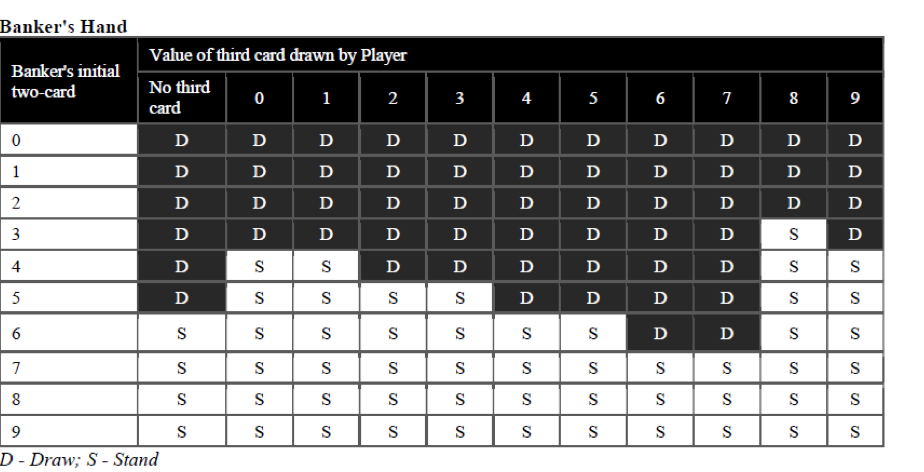
If the Player's hand stands on a 6 or 7, then a Banker hand totaling 3, 4 or 5 must draw, while a Banker hand totaling 6 must stand.
Whoever gets the hand closest to a total of 9 wins.
Side Bets
*RTP based on optimal strategy for Player bet.
Lightning Baccarat
Game Objective
The objective in Lightning Baccarat is to predict whether Player or Banker hand will win by having the value closest to 9.
Game Rules
The game is hosted by a dealer and is played with eight standard 52-card decks. Card values are as follows:
- Aces are the lowest cards and are worth 1 point each.
- Cards from 2 to 9 are worth their numerical face values.
- 10s and face cards (jacks, queens and kings) are each worth 0.
Only the numeric value of each card is relevant in the main Baccarat game; each card's suit (hearts, spades, clubs or diamonds) is irrelevant.
Prior to each deal, you must place your bet on whether the Player or the Banker will win the round by having the hand with a value closest to 9.
If you believe that both the Player and Banker will hold hands of equal value, you also have the option to bet on Tie.
In addition, you can also bet on Player/Banker Pair (P/B Pair), which will pay if the first two cards dealt to the Player/Banker constitute a pair.
A Lightning fee of 20% will be added to each of your placed bets. For example, if your bet is 5, then 20% Lightning fee applied is 1, and your total bet will be 6. This total bet value will be visible on your screen.
Lightning Round
After your bets are accepted, the Lightning round occurs. During the Lightning round from one to five random Lightning cards are drawn from a virtual 52-card pack. These Lightning cards are then given randomly assigned Lightning multipliers of 2x, 3x, 4x, 5x or 8x. If your bet wins and contains card/s that are among the selected Lightning cards, your payout will be multiplied by the Lightning multiplier assigned to the card/s.
You will have a chance to win even more if two or more Lightning cards are dealt to the same bet spot. Those multipliers will be multiplied and your payout then will be multiplied by the the total multiplier! Your initial bet will be added on top of your winnings.
If the winning hand does not contain the revealed Lightning card/s, then the regular payout is applied. See “Payouts” section for detailed payout information.
After the Lightning Round has occurred, the dealer deals two initial cards to the Player and to the Banker. If the Player and Banker hold hands of equal value, the round ends in a tie. The Tie bet wins, and bets on the Player and Banker push (are returned). The Lightning fee for the pushed Player/Banker bets will not be returned.
Each hand's value is calculated by dropping the tens digit in a hand otherwise worth 10 or more. For example, a hand consisting of a 7 and a 9 is only worth 6 in Baccarat (because 16-10=6). Similarly, a face card plus a 9 will be worth 9.
If the Player or the Banker receives an initial two-card hand worth 8 or a 9 (a "natural" 8 or 9), no additional cards will be dealt to either hand.
If the Player and Banker receive initial two-card hands worth 0-7, the "Third Card Rule" is consulted to determine if a third card is to be dealt to either hand or both hands. The Player always goes first.
Player's Hand
- Player's initial two-card hand
- 0-1-2-3-4-5 Player draws a third card.
- 6-7 Player stands.
- 8-9 (a "natural") No third card to either hand.
Banker's Hand
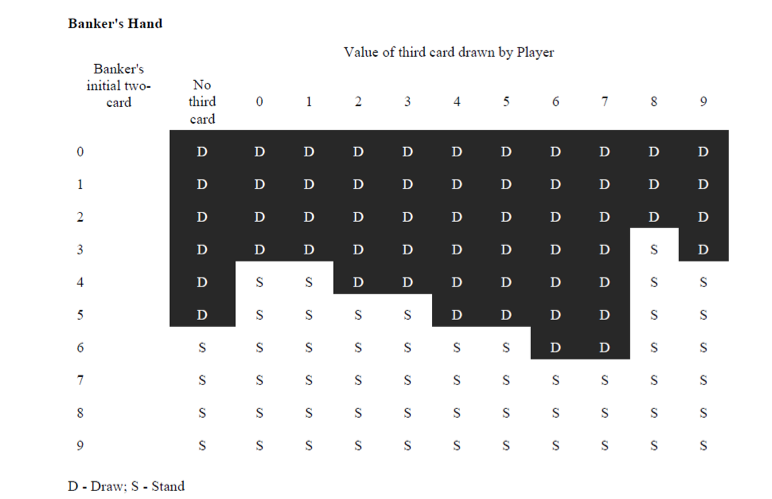
D - Draw; S - Stand
If the Player's hand stands on a 6 or 7, then a Banker hand totalling 3, 4 or 5 must draw, while a Banker hand totalling 6 must stand. Whoever gets the hand closest to a total of 9 wins.
Side Bets
First Person Games
First Person Dream Catcher (Money Wheel)
Game Objective
First Person Dream Catcher (Money Wheel) is a game of chance played using a large vertical wheel. The wheel is divided into 54 equal sectors separated by pins. 52 segments are marked with a number (1, 2, 5, 10, 20 and 40). The other two sectors – 2x multiplier and 7x multiplier – act as bonus spins and multiply your winnings if you win on the next spin. The objective of Dream Catcher is to predict at which of the numbered sectors the wheel will stop after spinning.
Game Rules
- Place your bet on a number you believe the wheel will stop at: 1, 2, 5, 10, 20 or 40. After you have placed your bets, click/tap the SPIN button to start spinning the wheel. After the wheel comes to a stop, the winning sector will be indicated by a pointer at the top of the wheel.
- If the wheel stops at the numbered sector you have placed your bet on, you win. All bets are paid with the odds matching the number in the winning sector: e.g. winning number 5 pays 5 to 1, winning number 10 pays 10 to 1, and so on. The bet placed on the winning sector is returned together with your winnings.
- Multipliers 2x and 7x
- If the wheel stops at one of the multiplier sectors marked as 2x or 7x, all your bets remain in place and no new bets are allowed. Click/tap the SPIN button to spin the wheel again and the outcome of the spin (1, 2, 5, 10, 20 or 40) will determine the winning odds as usual but the odds will be multiplied twice or seven times over, depending on which multiplier the wheel stopped at in the previous spin.
- If the SPIN button is not clicked/tapped within 5 seconds, the wheel will be spun automatically until it stops at any of the numbered sectors.
- If the wheel stops on a multiplier sector two or more times in a row, then all bets remain in place, and the multipliers stack: i.e. the multiplied payout from the last spin is multiplied again! The wheel is spun again automatically until it stops at any of the numbered sectors: 1, 2, 5, 10, 20 or 40. (For example, the wheel stops on 2x, then on the next spin it stops on 7x, and on the next spin on number 5. The outcome for the player who originally placed a bet on number 5, is: (5 to 1) x 2 x 7 = 70 to 1.
- Consecutive multipliers are unlimited subject to a default maximum win displayed in the Bet Limits panel.
Payouts
Maximum payout for your all winnings within a game round is limited. For details see the Bet Limit table.
Please note that any malfunction voids the game round and all eventual payouts for the round.
Return to Player
The optimal theoretical return-to-player (RTP) percentage is 95.65% (89.88% - 95.65%).
RTP based on optimal strategy for betting on number 10.
First Person Dragon Tiger
Game Objective
First Person Dragon Tiger is a unique, easy and fast game, where you can play at your own pace. Simply place your bets and click/tap the DEAL button to have the cards dealt for you. If you wish, you can have a number of free hands dealt to see the trends which can help you in predicting the results of future rounds. Click/tap the +1 button and a free hand will be dealt.
The game objective is to guess whether the Dragon or Tiger will draw the higher value card, and therefore win.
You can also bet on whether the Dragon and Tiger cards dealt will be of the same value, and therefore a Tie.
Game Rules
The aim of the Dragon Tiger is to predict which of the hands – the Dragon or the Tiger – will win or if it will be a Tie.
- The cards are dealt from a shoe with 8 decks (Jokers are excluded)
- Place your bet on either the Dragon, or Tiger, or Tie, or Suited Tie
- A single card is dealt face-up to the Dragon and to the Tiger
- Card value from the lowest to the highest is as follows: Ace with value 1, being the lowest and
- followed by 2 and so on, and King the highest (A-2-3-4-5-6-7-8-9-10-J-Q-K)
- If cards for the Dragon and Tiger are equal both in value and suit, it’s a Suited Tie, half of your main
- bet (the Dragon/Tiger bet) is returned and wins pay out 50:1
- The highest card wins and pays even money 1:1
- In the case of a Tie, half of your main bet (the Dragon/Tiger bet) is returned and wins pay out 11:1
Payouts
Your payout depends on the type of bet placed.
BETPAYSDragon1:1Tiger1:1Tie11:1Suited tie50:1
Please note that any malfunction voids the game round and all eventual payouts for the round. Bets will be returned.
Return to Player
The optimal theoretical return-to-player percentage:
- Main bet (Dragon/Tiger) – 96.27%
- Tie – 89.64%
- Suited tie – 86.02%
First Person Lightning Roulette
Game Objectives
First Person Lightning Roulette is an exciting game with electrifying roulette experience. In each game round from one to five "Lightning numbers" are randomly struck by lightning, allowing you to win 50x up to 500x (49:1 – to 499:1).
The objective in First Person Lightning Roulette is to predict the number on which the ball will land by placing one or more bets that cover that particular number. The wheel includes the numbers 1–36 plus a single 0(zero).
After you have placed your bets, click/tap the SPIN button. After the SPIN button is clicked/tapped, one to five "lucky numbers" will be randomly selected to have random multiplied "lucky payouts" applied on them. The ball will then be spun within the Roulette wheel and eventually come to rest in one of the numbered pockets within the wheel. You win if you have placed a bet that covers that particular number. If the winning number is among the randomly selected "lucky numbers" and is covered by your bet on a Straight Up bet, then you will be paid the multiplied "lucky payout".
Bet Types
You can place many different kinds of bets on the Roulette table. Bets can cover a single number or a certain range of numbers, and each type of bet has its own payout rate.
Bets made on the numbered spaces on the betting area, or on the lines between them, are called Inside Bets, while bets made on the special boxes below and to the side of the main grid of numbers are called Outside Bets.
INSIDE BETS:
- Straight Up - place your chip directly on any single number (including zero).
- Split Bet - place your chip on the line between any two numbers, either on the vertical or horizontal.
- Street Bet - place your chip at the end of any row of numbers. A Street Bet covers three numbers.
- Corner Bet - place your chip at the corner (central intersection) where four numbers meet. All four
- numbers are covered.
- Line Bet - place your chip at the end of two rows on the intersection between the two rows. A line bet covers all the numbers in both rows, a total of six numbers.
OUTSIDE BETS:
- Column Bet - place your chip in one of the boxes marked "2 to 1" at the end of the column that covers all 12 numbers in that column. The zero is not covered by any column bet.
- Dozen Bet - place your chip in one of the three boxes marked "1st 12," "2nd 12" or "3rd 12" to cover the 12 numbers alongside the box.
- Red/Black - place your chip in the Red or Black box to cover the 18 red or 18 black numbers. The zero is not covered by these bets.
- Even/Odd - place your chip in one of these boxes to cover the 18 even or 18 odd numbers. The zero is not covered by these bets.
- 1-18/19-36 - place your chip in either of these boxes to cover the first or second set of 18 numbers. The zero is not covered by these bets.
After you have clicked/tapped the SPIN button, the randomly selected "lucky numbers" with their "lucky payouts" will be highlighted on the betting grid.
Neighbour and Special Bets
Each bet covers a different set of numbers and offers different payout odds. Bet spots will be highlighted.
Tiers du Cylindre
This bet covers a total of 12 numbers that include 27, 33 and the numbers that lie between them on the side of the Roulette wheel opposite to zero. 6 chips are placed as follows:
- 1 chip on the 5/8 split
- 1 chip on the 10/11 split
- 1 chip on the 13/16 split
- 1 chip on the 23/24 split
- 1 chip on the 27/30 split
- 1 chip on the 33/36 split
Orphelins a Cheval
This bet covers a total of 8 numbers on the two segments of the Roulette wheel not covered by the voisins du zero and tiers du cylindre bets above. 5 chips are placed as follows:
- 1 chip on 1 (Straight up)
- 1 chip on the 6/9 split
- 1 chip on the 14/17 split
- 1 chip on the 17/20 split
- 1 chip on the 31/34 split
Voisins du Zero
This bet covers a total of 17 numbers that include 22, 25 and the numbers that lie between them on the side of the Roulette wheel that contains zero. 9 chips are placed as follows:
- 2 chips on the 0/2/3 street
- 1 chip on the 4/7 split
- 1 chip on the 12/15 split
- 1 chip on the 18/21 split
- 1 chip on the 19/22 split
- 2 chips on the 25/26/28/29 corner
- 1 chip on the 32/35 split
Jeu Zero
This bet covers zero and the 6 numbers in close proximity to zero on the Roulette wheel: 12, 35, 3, 26, 0, 32 and 15. 4 chips are placed as follows:
- 1 chip on the 0/3 split
- 1 chip on the 12/15 split
- 1 chip on 26 (Straight up)
- 1 chip on the 32/35 split
A neighbour bet covers a particular number as well as other numbers that lie in close proximity to it on the Roulette wheel. To place a neighbour bet, click/tap a specific number on the racetrack. A chip will be placed on the chosen number and on numbers that neighbour it to the right and left. Click/tap on the circular "-"or "+" button to increase or decrease the set of neighbours to the right and left of the chosen number.
Winning Numbers
The WINNING NUMBERS display shows the most recent winning numbers.
Payouts
Your payout depends on the type of placed bet.
INSIDE BETS
Malfunction voids all pays and play.
Return to Player
- The optimal theoretical return-to-player (RTP) for a Straight Up bet is 97.10%.
- The optimal theoretical RTP for all other bets is 97.30%.
First Person Football Studio (Top Card)
Game Objective
First Person Football Studio (Top Card) allows you to play the very easy and fast-paced Top Card game. The game objective is to guess which hand – Home (A) or Away (B) – will draw the higher value card, and therefore win.
The player may also guess whether the cards dealt for Home (A) and Away (B) hands will be of the same value, by placing a bet on Away (B).
Game Rules
The aim of the First Person Football Studio is to predict which of the hands – Home (A) or Away (B) – will win or if they will be of the same value - Draw (X).
- The cards are dealt from a shoe with 8 decks (Jokers are excluded)
- The player places a bet on either Home (A), Away (B) or Draw (X)
- A single card is dealt face-up to Home (A) and to Away (B). The highest card wins and pays even money 1:1
- Card value from the lowest to the highest is as follows: 2, being the lowest and followed by 3 and so on, and Ace the highest (2-3-4-5-6-7-8-9-10-J-Q-K-A)
- If the hands dealt are of the same value, half of player's main bet (Home (A) or Away (B)) is returned and, if the player has placed a Draw (X) bet, wins pay out 11:1
Payouts
Your payout depends on the type of bet placed.
Please note that any malfunction voids the game round and all eventual payouts for the round. Bets will be returned.
Return to Player
The optimal theoretical return-to-player percentage:
- Main bet (Home (A)/Away (B)) – 96.27%
- Draw (X) – 89.64%
First Person Mega Ball
Game Objective
First Person Mega Ball is a unique, entertaining and fast-paced game show, featuring a Mega Ball Bonus round in which you have the chance to win even more with the added multipliers! Buy a packet of cards to play with for the value you have selected and simply complete lines of numbers on your card/s, while the numbered balls are being randomly drawn by the Ball drawing machine. It’s all about getting as many lines per card as possible – the more lines you get, the more you win!
Game Rules
First Person Mega Ball is played with 1 – 200 cards and a Ball drawing machine. Each 5x5 cell card contains 24
randomly arranged unique numbers with a free square in the centre. The free square is considered as an already marked square. You win if you get a horizontal, vertical or diagonal line of 5 squares. You can win up to 12 lines per card.
Main Game Round
- Buy a packet of cards you wish to play with for the value you have selected. You can add more card packets after the first packet is bought and change the value of your cards while the betting time is open. Your selected card value will be automatically applied to all your cards.
- Your cards will be visible on the screen regardless of the amount. You can zoom in on an individual card at any time. If you would like to change the numbers on a particular card, simply zoom in on that card and while the betting time is open, click/tap the REFRESH NUMBERS button until you are satisfied with the resulting new numbers.
- Once you have bought your cards, click/tap PLAY button to start the ball drawing. 20 out of 51
- numbered balls are drawn from the Ball drawing machine.
- If the number of the drawn ball matches a number in any of your cards, a badge is automatically placed on that number. When a completed line is collected, your winnings per card are also updated automatically and displayed below the corresponding card.
- As the balls are drawn one by one, your cards will be automatically updated and sorted, with the card closest to winning placed at the top.
- To add to the excitement, you can also see on your screen how much you could win if a special ball should happen to be drawn. Expected ball numbers will be highlighted in gold on your cards.
- The drawn balls are also automatically updated and visible on your screen.
Mega Ball Bonus round
- After all 20 balls are drawn in the main game round, one or two intriguing Mega Ball Bonus rounds occur. At the beginning of the Mega Ball Bonus round, a Mega Ball multiplier in the range from 5x to 100x is generated. An additional ball is drawn from the Ball drawing machine to determine the number of the Mega Ball.
- If the Mega Ball number completes any line in your card/-s, your payout on that card is multiplied by the Mega Ball multiplier.
- If a line is not complete, the Mega Ball number will be treated as a regular ball and will not multiply the payout.
- If there is more than one Mega Ball among your winning lines on the same card, your payout will be multiplied only by the highest multiplier.
Game result
After the game round is over, your cards are sorted again and only those cards with winnings are left on the screen. Your total winnings are calculated automatically and displayed on your screen.
Payouts
Maximum payout for all your winnings within a game round is limited. For details see the Bet Limit table.
Please note that any malfunction voids the game round and all eventual payouts for the round. Bets will be returned.
Return to Player
The optimal theoretical return-to-player (RTP) percentage is 95,40%, based on 1 card.
The RTP range is 95,05% – 95,40%.
First Person Blackjack
Game Objective
The objective of First Person Blackjack is to achieve a higher card count than the virtual dealer, but without exceeding 21. The best hand is Blackjack – when the sum of values of the first two dealt cards is exactly 21.
- Played with 8 decks.
- Cards shuffled before each game.
- Dealer always stands on 17.
- Double Down on any two initial cards.
- Split initial cards of equal value.
- Only one Split per hand.
- Single card dealt to each Split Ace.
- No Double Down after Split.
- Insurance offered when dealer shows an Ace.
- Blackjack pays 3 to 2.
- Insurance pays 2 to 1.
- Push game when hands tie.
Game Rules
The game is played with 8 standard 52-card decks. Card values are as follows:
- Cards from 2 to 10 are worth their face value.
- Face cards (Jacks, Queens and Kings) are each worth 10.
- Aces are worth 1 or 11, whichever is more favorable to the hand. Note that a soft hand includes an Ace worth 11.
Five hands are available. You can place your bets on one or multiple hands. After you have placed your bets, click/tap the DEAL NOW button to start the dealing. Dealing starts from the hand closest to the ‘shoe’ and continues clockwise, ending with the virtual dealer. One card is dealt face-up to each hand and the virtual dealer.
Afterwards, the second card is dealt face-up to each hand and the last card is dealt face-down to the virtual dealer. The value of each initial hand is displayed next to the cards for each hand.
Blackjack
If the value of your initial two-card hand is exactly 21, you have Blackjack!
Insurance
If the virtual dealer’s upcard is an Ace, you are given the option to purchase insurance to offset the risk that the virtual dealer has Blackjack – even when you have Blackjack yourself. The amount of insurance equals half of your main bet, and the insurance bet is settled separately from the bet on your hand. The virtual dealer’s downcard is then checked for Blackjack. If there is no Blackjack, the round continues. If the virtual dealer has Blackjack, but you don’t, the virtual dealer’s hand wins. If you both have Blackjack, the game ends in a push and your bet is returned. Note that when the virtual dealer’s upcard is a 10 or face card, you will not be given the option to purchase insurance, and the virtual dealer’s downcard will not be checked for Blackjack.
Double Down, Hit or Stand
When the virtual dealer does not have Blackjack upon checking the two initial cards, players are given the chance to improve the values of their hands in turn by choosing to have further cards dealt.
If the value of your initial hand is not 21, you can decide to Double Down. In this case, you will double your bet and be dealt only one additional card to add to your hand. Alternatively, you can decide to Hit to be dealt an additional card to add to the value of your hand. You can Hit more than once to receive additional cards before you decide to Stand once you are satisfied with the value of your hand.
Split
If your initial hand is a pair of cards of equal value, you can decide to Split the pair to make two separate hands, each with a separate bet equal to the main bet. After a second card is dealt to both of your hands, you can improve the value of these two hands by deciding to Hit. Again, you can choose to Stand once you are satisfied with the value of your two hands. However, if you Split an initial pair of Aces, you will receive only one additional card per hand with no option to Hit.
Outcome
If the sum of your hand exceeds 21, you bust and lose your bet on that hand.
When decisions have been made for all hands, the virtual dealer’s downcard is revealed. The virtual dealer must
Hit on a hand of 16 or less and must Stand on a hand of soft 17 or more. (Remember that a 'soft hand' includes an Ace worth 11.)
You win when the value of your final hand is closer to 21 than the virtual dealer’s hand or when the dealer busts. If the hand value is the same, the game round ends in a push and your bet is returned.
Blackjack is only possible using the two cards in the initial two-card deal. A hand of 21 resulting from a split pair is not considered a Blackjack. Therefore, Blackjack beats any hand of 21 resulting from a split pair.
Side Bets
This First Person Blackjack game also includes optional side bets – Perfect Pairs and 21+3. Please note that the main bet is required to place side bets. You have the chance to win on any side bet whether you later win or lose on your main bet.
Perfect Pairs
The Perfect Pairs side bet gives you a chance to win if your first two cards comprise any pair – for example, two Queens, two Aces or two 3s. There are three types of pairs, each with a different payout:
- Perfect Pair – same suit, e.g. two Aces of Spades.
- Coloured Pair – different suits of the same colour, e.g. 2 of Diamonds + 2 of Hearts.
- Mixed Pair – different suits of a different colour, e.g. 10 of Hearts + 10 of Clubs.
21+3
The 21+3 side bet gives you a chance to win if your first two cards plus the dealer’s up-card comprise any of the following winning combinations (similar to those in poker), each with a different payout:
- Suited Trips – an identical triplet, e.g. 3 Queens of Hearts.
- Straight Flush – in numerical sequence and same suit, e.g. 10, Jack and Queen of Diamonds.
- Three of a Kind – same value but different suits, e.g. any 3 non-matching Kings.
- Straight – in numerical sequence but different suits, e.g. 2 of Spades + 3 of Clubs + 4 of Hearts.
- Flush – non-sequential cards in the same suit, e.g. 2, 6 and 10 of Clubs.
Payouts
- Blackjack pays 3:2.
- Winning hand pays 1:1.
- Insurance pays 2:1.
Please note that any malfunction voids the game round and all eventual payouts for the round.
Return to Player
- Blackjack - 99.28%%.
- Perfect Pairs bet – 95.90%.
- 21+3 bet – 96.30%.
First Person Baccarat
Game Objective
The objective in First Person Baccarat is to predict whose hand will win by having the value closest to 9.
Game Rules
First Person Baccarat is played with eight standard 52-card decks. Card values are as follows:
- Aces are the lowest cards and are worth 1 point each.
- Cards from 2 to 9 are worth their numerical face values.
- 10s and face cards (jacks, queens and kings) are each worth 0.
Cards are burnt after each shuffle. At the start of a new shoe, one card is drawn face-up from the shoe. The number of cards to be burnt depends on the face value of the first drawn card. In this card burning procedure, 10s and face cards will have a face value of 10 and will result in 10 cards burnt. Cards are burnt by placing them in the burnt card holder.
Only the numeric value of each card is relevant in the main Baccarat game; each card's suit (hearts, spades, clubs or diamonds) is irrelevant.
Prior to each deal, your bet has to be placed on whether the Player or the Banker will win the round by having the hand with a value closest to 9. You also have the option to bet that the round will end in a Tie, which occurs when both the Player and Banker hold hands of equal value.
Two cards are dealt each to the Player and to the Banker.
Two hands are dealt in Baccarat: one hand to the Player and one hand to the Banker.
If the Player and Banker hold hands of equal value, the round ends in a tie. The Tie bet wins, and bets on the Player and Banker push (are returned).
Each hand's value is calculated by dropping the tens digit in a hand otherwise worth 10 or more. For example, a hand consisting of a 7 and a 9 is only worth 6 in Baccarat (because 16-10=6). Similarly, a face card plus a 9 will be worth 9.
If the Player or the Banker receives an initial two-card hand worth 8 or a 9 (a "natural" 8 or 9), no additional cards will be dealt to either hand.
If the Player and Banker receive initial two-card hands worth 0-7, the "Third Card Rule" is consulted to determine if a third card is to be dealt to either hand or both hands. The Player always goes first.
Player's Hand
- Player's initial two-card hand
- 0-1-2-3-4-5 Player draws a third card.
- 6-7 Player stands.
- 8-9 (a "natural") No third card to either hand.
Banker's Hand
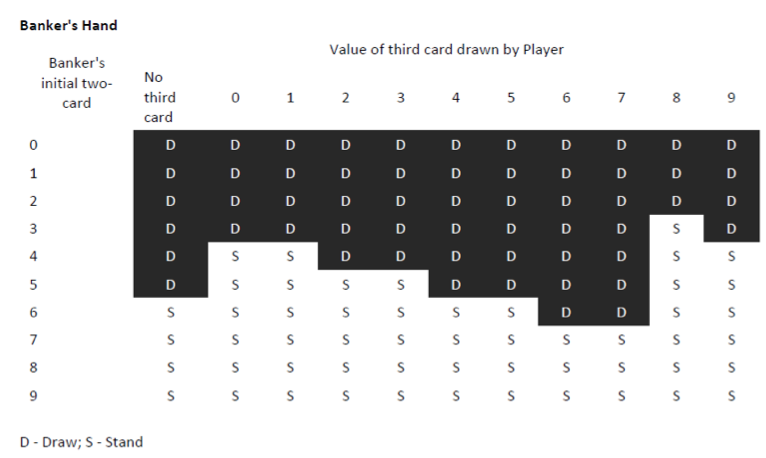
If the Player's hand stands on a 6 or 7, then a Banker hand totalling 3, 4 or 5 must draw, while a Banker hand totalling 6 must stand.
Whoever gets the hand closest to a total of 9 wins.
Side Bets
Please note that any malfunction voids the game round and all eventual payouts for the round. Bets will be returned.
* Payout for Banker bet in No Commission Baccarat
** Applicable to No Commission Baccarat
Return to Player
The optimal Return to Player (RTP) percentage for First Person Baccarat is 98.76%, based on Player bet for No Commission Baccarat.
The following table displays the return-to-player percentage on the different optional side bets.
